The proportion of steel used in the construction industry decreased from 58% in 2020 to 49% in 2025, while the proportion used in the manufacturing industry increased from 42% to 51%, marking the first time in my country's history that steel consumption in the manufacturing sector exceeded that in the construction industry.
Steel is the backbone of industrial civilization and an indispensable basic raw material for building a modern nation. From the first batch of molten iron flowing from the blast furnace of Anshan Iron and Steel Group in 1949 to Baosteel building a modern production line on the banks of the Yangtze River, China's steel industry has completed in just over seventy years the industrialization process that took developed countries more than two hundred years, and with an annual output exceeding one billion tons, it has elevated China's status as a manufacturing powerhouse.
Since the 14th Five-Year Plan, the development logic of China's steel industry has continued to undergo profound adjustments. During the 14th Five-Year Plan period, the average annual steel consumption of the real estate industry, a major user of steel, decreased to approximately 270 million tons, a decrease of about 13% compared to the 13th Five-Year Plan period. According to the National Bureau of Statistics, my country's steel production in 2025 will reach 1,446.12 million tons, an increase of 3.1% year-on-year.
With major clients retreating and total output increasing, where has China's steel industry gone?
An investigation by reporters reveals that the steel tide has quietly shifted away from the concrete jungle of construction, deeply penetrating various industries such as new energy, high-end manufacturing, and marine engineering. The steel industry is bidding farewell to "scale expansion and quantity competition" and entering a new model of "reducing quantity and improving quality, increasing efficiency and upgrading," ushering in a new era of winning through quality, moving towards innovation, and leaping in value.
For the first time, steel consumption in manufacturing has surpassed that in construction.
Reporters learned that the proportion of steel used in the construction industry will decrease from 58% in 2020 to 49% in 2025, while the proportion used in the manufacturing industry will increase from 42% to 51%. "For the first time in my country's history, steel used in the manufacturing industry has surpassed that used in the construction industry. This is the result of the steel industry adapting to changes in demand and promoting product quality upgrading."
Value Reshaping from Rebar to Invar Steel
The entire industry is climbing towards higher value chains. Xu Xiangchun told reporters, "In the past, large quantities of ordinary construction steel products such as rebar and wire rod were being replaced by high-tech, high-value-added products. The structural upgrading of downstream demand has also driven the entire steel industry to achieve a value leap." Data released by the Metallurgical Industry Planning and Research Institute at the end of 2025 showed that 16 steel companies nationwide were close to or had reached world-class levels. This is not only an optimization of production capacity, but also a microcosm of China's manufacturing industry moving from "large" to "strong" and towards excellence.
From supporting China to benefiting the world
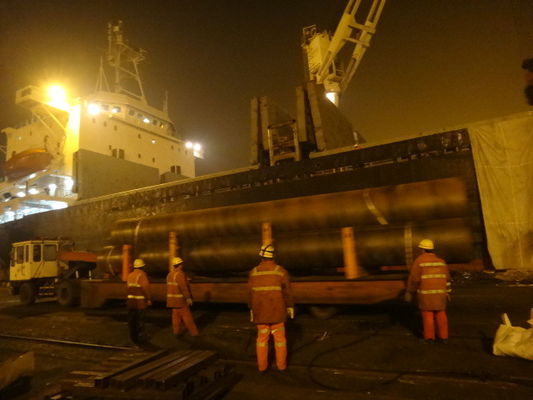
China's steel market boundaries are also expanding. Since becoming a net exporter of steel in 2006, China's share of global steel exports has steadily increased, gradually making it a core player in the global steel export market. China's stable steel supply is helping many countries advance infrastructure and industrial system construction.
Serving the Belt and Road Initiative and supporting the development of developing countries. According to data from the General Administration of Customs, my country exported 119 million tons of steel in 2025, a year-on-year increase of 7.5%; the total export value reached US$82.63 billion. Li Gang believes that the growth of China's steel exports is due to several factors, including significant cost advantages, internationally benchmarked quality, and a complete range of product varieties.
Regional distribution: While Asia still dominates China's steel export market, it is becoming increasingly diversified, gradually shifting towards emerging markets with more active demand along the Belt and Road.
In recent years, my country's newly undertaken overseas contracted projects in Belt and Road participating countries and regions involve multiple fields such as power engineering, housing, transportation, petrochemicals, and communications engineering. Steel is a crucial raw material for these projects. From the Jakarta-Bandung High-Speed Railway to the China-Laos Railway, from power plants in Serbia to line upgrades in South Africa, infrastructure projects in the Middle East, Southeast Asia, Africa, and South America are progressing steadily under the Belt and Road Initiative, creating stable demand for Chinese steel.


 Your message must be between 20-3,000 characters!